
If you have searched for "what is the process of air duct cleaning," you have probably seen two very different jobs sold under the same name. One is a careful cleaning of the whole heating and cooling system. The other is a quick pass with a vacuum hose at a few registers. Both get called "duct cleaning," and both get advertised to Reno homeowners. Knowing what the real process looks like is the easiest way to tell them apart when you compare quotes.
Reno Air Duct Cleaning doesn't do the work ourselves. We connect Reno-area homeowners with independent local duct cleaning and HVAC companies for free, no-obligation quotes. This guide is here so you know what to expect and what to ask.
What "source removal" means
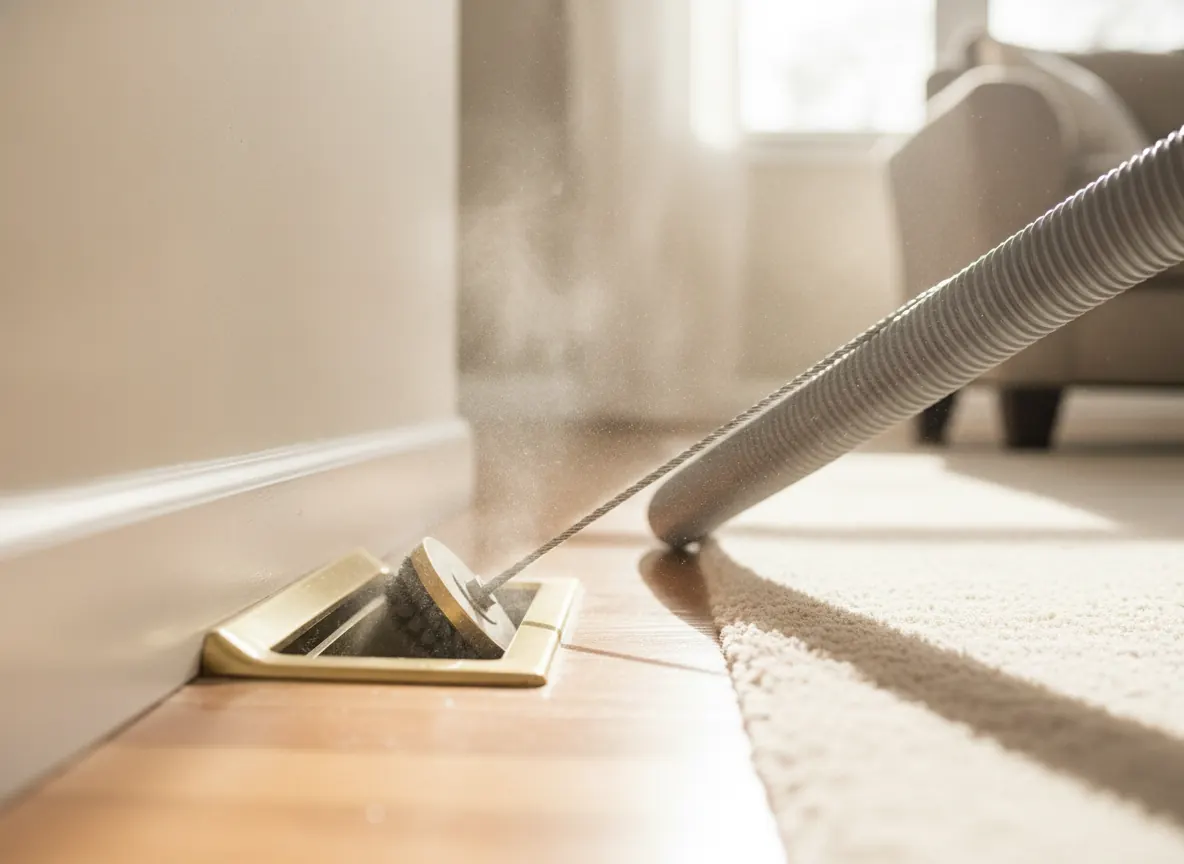
NADCA's consumer FAQ puts it plainly: "The most effective way to clean air ducts and ventilation systems is to employ source removal methods of cleaning. This requires a contractor to place the system under negative pressure, through the use of a specialized, powerful vacuum. While the vacuum draws air through the system, devices are inserted into the ducts to dislodge any debris that might be stuck to interior surfaces. The debris can then travel down the ducts to the vacuum, which removes it from the system and the home."
In short, there are two halves to the job, and both have to happen at the same time:
- Negative pressure. A powerful vacuum, often a truck-mounted unit or a portable "negative air machine," is connected to the duct system so air is constantly pulled toward it. NADCA's process page says "the entire HVAC system is placed under continuous negative pressure — with a vacuum — to prevent the spread of contaminants."
- Agitation. Tools go into the ducts to knock loose what is stuck to the walls. NADCA names "brushes, air whips and 'skipper balls'" as examples, and adds that "a vacuum collection device alone will not get an HVAC system clean."
That second point answers a common question: which duct cleaning method works? Neither suction alone nor brushing alone. Rotary brush systems (sometimes sold under brand names like "rotobrush") are one form of agitation. Air whips and skipper balls are others. What matters is that the loosened debris is captured by the vacuum instead of blowing into your living room.
HEPA and where the dust goes
NADCA states that "any vacuum collection device which exhausts indoors must be HEPA filtered." EPA's guidance says the same thing from the homeowner's side: the provider should "use vacuum equipment that exhausts particles outside of the home or use only high-efficiency particle air (HEPA) vacuuming equipment if the vacuum exhausts inside the home."
This matters more than it sounds. EPA warns that "an inadequate vacuum collection system can release more dust, dirt and other contaminants than if you had left the ducts alone." A shop vac with an ordinary filter, parked in your hallway, is not source removal.
It's more than the ducts
EPA defines duct cleaning broadly. It "generally refers to the cleaning of various heating and cooling system components of forced air systems, including the supply and return air ducts and registers, grilles and diffusers, heat exchangers heating and cooling coils, condensate drain pans (drip pans), fan motor and fan housing, and the air handling unit housing."
EPA also explains why that scope matters: "Failure to clean a component of a contaminated system can result in re-contamination of the entire system." If a quote covers only the vents you can see, ask what happens to the blower, the coil and the air handler. In Reno, where furnaces carry most of the load (the Reno-Tahoe airport averages about 4,669 heating degree days a year against 1,038 cooling degree days, per NOAA 1991–2020 normals), the furnace cabinet and blower see a lot of hours. Note that coil and blower work can involve removing parts, which is HVAC service work; see our furnace and coil cleaning page.
What a thorough job looks like, step by step
Every company runs its own process, and NADCA's full standard (the ACR, The NADCA Standard for the Assessment, Cleaning, and Restoration of HVAC Systems, 2025 Edition) is far more detailed than this. But EPA's homeowner checklist gives a clear outline. A provider should:
Inspect first
Look at the system and show you the contamination. EPA says to "ask them to show you the contamination that would justify having your ducts cleaned." EPA also says the provider should check for asbestos-containing materials before starting.
Open access
"Open access ports or doors to allow the entire system to be cleaned and inspected." Cleaning only through the register openings limits what can be reached.
Put the system under vacuum
Connect the collection equipment, exhausting outside or through HEPA filtration, and keep it running while cleaning.
Agitate with care
"Use well-controlled brushing of duct surfaces in conjunction with contact vacuum cleaning." For fiberglass duct board, EPA says to "use only soft-bristled brushes."
Close up properly
Seal and re-insulate any access holes made in the ducts.
Verify
EPA: "All portions of the system should be visibly clean; you should not be able to detect any debris with the naked eye." NADCA agrees: "If any dust or debris can be seen during the visual inspection, the system should not be considered cleaned."
Our process page walks through the same steps in more detail.
Where sanitizers fit (and where they don't)
Some companies offer to spray or fog a sanitizer after cleaning. Whether to ask about it is your choice, but go in with EPA's cautions in mind. EPA says "research has not demonstrated their effectiveness in duct cleaning or their potential adverse health effects," and "no chemical biocides are currently registered by EPA for use in internally-insulated air duct systems." Any treatment "should only be applied, if at all, after the system has been properly cleaned of all visible dust or debris." If you allow one, EPA says the provider should show you the label and apply it only to un-insulated areas. NADCA says antimicrobial treatments "aren't part of a typical duct cleaning job."
Source removal vs. "blow-and-go"
NADCA warns homeowners to "beware of 'blow-and-go' air duct cleaning companies. These companies often advertise low prices but deliver minimal cleaning, then attempt to convince homeowners to purchase additional services that may not be needed." NADCA also says to "avoid advertisements for '$99 whole house specials' and other sales gimmicks."
A real source-removal job takes equipment, time and access to the whole system, which is why EPA and NADCA both put typical whole-system cleaning at roughly $450–$1,000. Our air duct cleaning cost guide has the full range of estimates, and our post on the $99 duct cleaning scam covers the red flags.
Questions to ask before you hire
- Will the whole system be under negative pressure the entire time? Where does the vacuum exhaust, and is it HEPA filtered if it's indoors?
- What agitation tools will you use, and are they safe for my type of duct (sheet metal, flex duct or duct board)?
- Does the price include the blower, coil, drain pan, air handler and every register, or only some of them?
- Will you cut access openings, and how will they be sealed?
- Can I see the inside of the ducts before and after?
- What is your Nevada State Contractors Board license number? Nevada requires contractors to show their license number in their ads; check any company on the NSCB license search before you hire. Our guide on checking a Nevada contractor license shows how.
- Will I get a written agreement with the total cost and scope before work begins? EPA recommends it.
About certifications: NADCA says membership requires at least one Air Systems Cleaning Specialist (ASCS) on staff, and you can confirm a company through NADCA's "Find a Professional" directory. EPA, on the other hand, "neither establishes duct cleaning standards nor certifies, endorses, or approves duct cleaning companies," so any claim of being "EPA certified" is a warning sign.
Is it worth doing at all?
Understanding the method doesn't mean every home needs it. EPA recommends cleaning only as needed: when there is substantial visible mold in hard-surface ducts, when ducts are infested with vermin, or when they are clogged with excessive dust and debris or particles are released from the supply registers. If none of that applies, read is air duct cleaning worth it? before you book anything.
If you do want a cleaning, the simplest protection is a few written quotes that spell out the method. Request free quotes from independent local companies serving Reno, Sparks and the Truckee Meadows, and compare them against the checklist above.